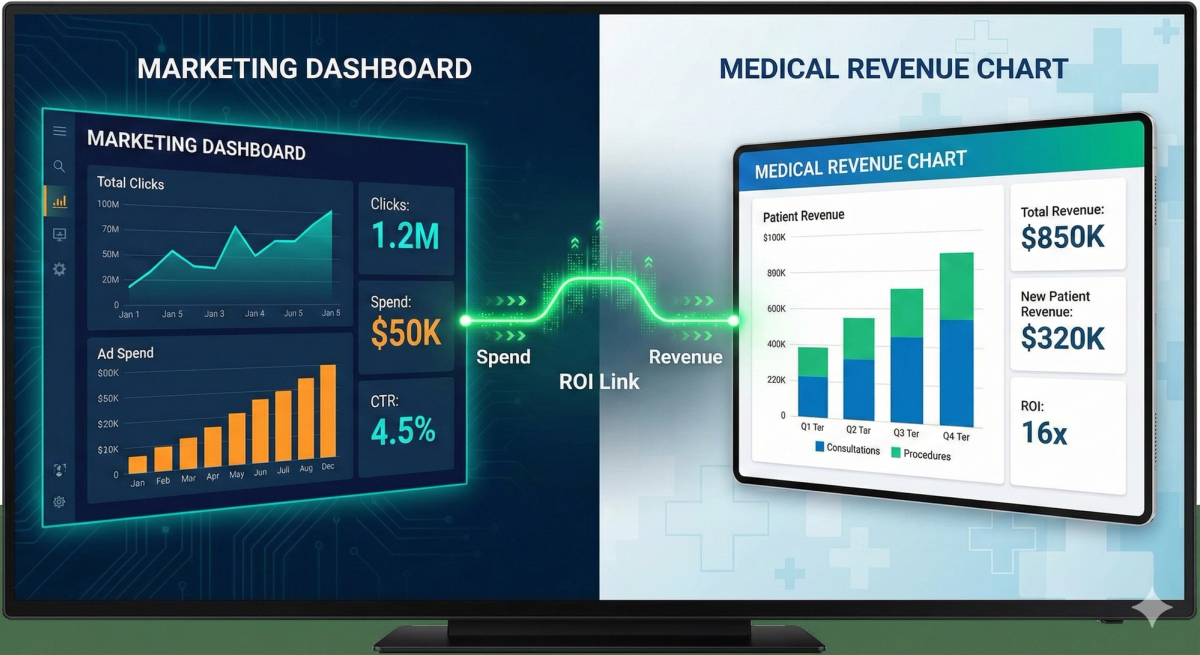
How to Measure ROI in Healthcare Digital Marketing
Healthcare marketing has a math problem.
In most industries, calculating Return on Investment (ROI) is simple: you spend $100 on ads, sell $200 in products, and your ROI is 100%.
In healthcare, it is rarely that straight forward. The patient journey is non-linear, privacy regulations (HIPAA) block data visibility, and the "value" of a patient might not be realized for months or years after their first appointment.
Yet, with healthcare organizations facing tighter margins in 2025, marketing leaders can no longer rely on "vanity metrics" like clicks or impressions. You need to prove that every dollar spent is driving patient volume and revenue.
Here is the executive roadmap to accurately measuring ROI in healthcare digital marketing—and the metrics that actually matter.
Why ROI is Different in Healthcare
Before fixing your formulas, you must accept three realities of the US healthcare market:
- The Privacy Gap: You cannot simply upload patient lists to Google or Facebook to see who converted. HIPAA regulations strictly limit how you match marketing data to patient health records (PHI).
- The Payor Mix: Not all patients have the same financial value. A lead for a specialized surgery with commercial insurance is worth significantly more than a generic inquiry. Basic "Cost Per Lead" (CPL) metrics fail to account for this revenue disparity.
- The Long Sales Cycle: A patient may click an ad for an orthopedist today but not book surgery for six months. If your attribution window is only 30 days, you will undervalue your marketing efforts.
The Core Formulas
To get a true picture of performance, you need to move beyond "Cost Per Click" (CPC). Focus on these three financial metrics.
1. Patient Acquisition Cost (PAC)
This is the total cost to get a new patient in the door. It is the most critical metric for operational budgeting.
- Formula:
Total Marketing Spend / New Patients Booked - 2025 Benchmark: While this varies wildly by specialty, efficient benchmarks often land between $150–$300 for dental and primary care, while competitive specialties like orthopedics or plastic surgery may see PACs range from $500–$1,000+.
2. Patient Lifetime Value (LTV)
Marketing often looks expensive if you only look at the first visit. LTV looks at the long-term value.
- Formula:
(Average Revenue Per Visit × Visits Per Year) × Average Retention Years - Why it matters: If you spend $300 to acquire a patient who only spends $150 on a consultation, you appear to be losing money. But if that patient returns quarterly for 5 years, that $300 investment generated thousands in revenue.
3. Marketing-Originated Revenue (ROMI)
This measures the direct revenue impact of your campaigns.
- Formula:
(Marketing Revenue - Marketing Cost) / Marketing Cost × 100 - Target: A healthy benchmark for mature healthcare marketing programs is a 3:1 to 5:1 ratio. For every $1 spent, you should generate $3-$5 in revenue.
The Attribution Challenge: Tracking Without Violating HIPAA
The biggest hurdle is connecting the Click (Marketing Data) to the Patient (EHR Data) without exposing Protected Health Information (PHI).
Standard Google Analytics setups are often non-compliant because URLs can accidentally capture PHI. To solve this, you need a "Closed-Loop" Analytics Stack:
- Call Tracking: Use HIPAA-compliant call tracking software (like CallRail) to attribute phone calls to specific keywords or ads without recording sensitive medical details.
- De-identified CRM Matching: Use a CRM (like Salesforce Health Cloud or HubSpot) to serve as a secure bridge. Marketing data lives in one silo, patient data in another, and they are matched via anonymized IDs—never PII.
- Server-Side Tracking: Move tracking pixels off the user's browser (where they are vulnerable) to a secure server. This is a service our Analytics Team specializes in to keep clients compliant.
Which Channels Drive the Best ROI?
Not all channels are created equal. Measuring them requires different approaches:
- Local Service Ads (LSAs): These are the easiest to measure. You pay per lead (phone call), making the ROI calculation immediate and transparent.
- Programmatic Display & CTV: These are "Top of Funnel" awareness drivers. Measuring their ROI requires looking at "View-Through Conversions"—patients who saw an ad, didn't click, but later searched for your brand and booked.
- SEO (Search Engine Optimization): SEO has the highest long-term ROI because you don't pay for clicks. However, it requires patience. Measure SEO ROI over 6-12 month windows, not weekly.
Data is Your Competitive Advantage
In 2026, the healthcare providers who win will be the ones who treat marketing as an investment portfolio, not an expense. By implementing proper tracking and focusing on LTV over cheap clicks, you can protect your margins and scale your practice with confidence.
Is your tracking setup HIPAA-compliant? Stop guessing your numbers. Contact Autum Digital today for a comprehensive analytics audit.