CTV Advertising for Healthcare Providers: A Beginner's Guide
August 27, 2026
For decades, "TV advertising" meant one thing for healthcare organizations: an expensive, imprecise bet. You bought a local news spot and hoped the right person was watching.
Connected TV (CTV) has rewritten that equation.
CTV — advertising delivered through streaming platforms like Hulu, Roku, and connected smart TVs — now lets healthcare marketers do something broadcast television never could: reach a specific household, a specific physician, or a specific family actively researching care, with the same precision as a search ad. For hospitals, senior living communities, and medical device companies, that shift matters. Here's what CTV advertising actually is, who it's for, and how to think about using it.
What Is CTV Advertising, Exactly?
CTV advertising refers to video ads served through internet-connected television — think a Hulu pre-roll, a Roku Channel spot, or an ad inside a smart TV app — as opposed to ads bought through a traditional cable or broadcast contract.
The distinction matters because of how it's bought. Traditional TV is sold on broad demographics — "adults 35-64 in the Cleveland market." CTV is sold programmatically, meaning ad space is purchased in real time, impression by impression, using audience data rather than a whole media market. That's what makes it addressable: you're not buying an audience of thousands hoping a few are relevant. You're targeting the households and viewers who actually match your criteria.
For healthcare organizations, that opens up two very different use cases.
Two Audiences, One Channel
1. Reaching Patients and Families
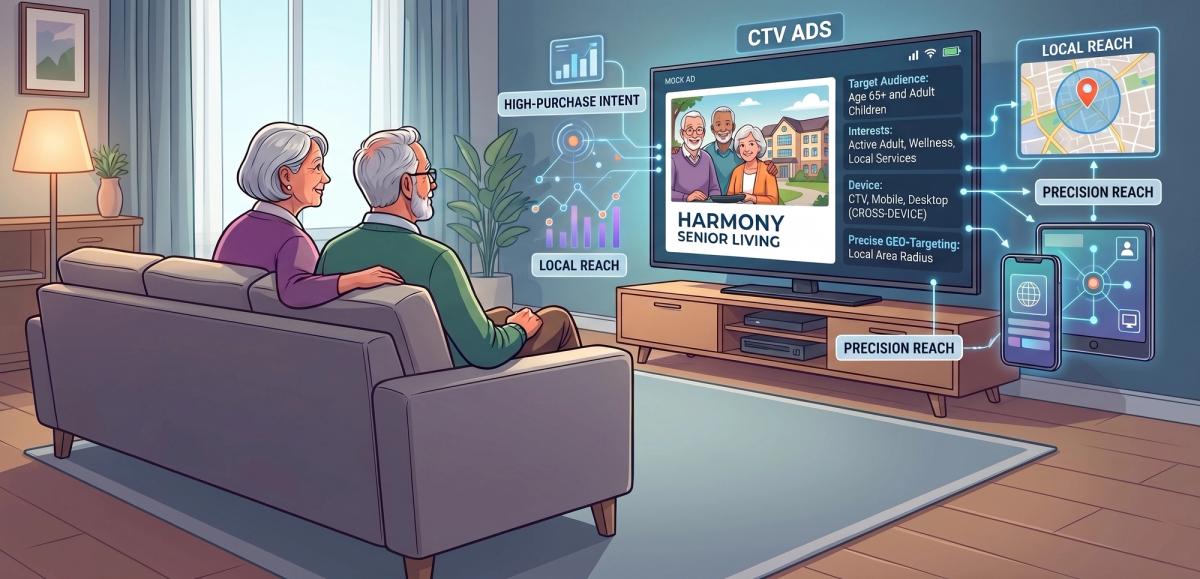
Connected TV has effectively become the new "local news" — it's where families sit down in the evening, often while researching a health decision on a second screen at the same time. Using household-level and geographic data, healthcare marketers can serve video ads to families who are actively searching for care options, or who live in zip codes with a high concentration of the right audience.
This is especially powerful for senior living and Distinguished Senior Organizations (DSOs), where the decision-maker is rarely the resident — it's an adult child, often researching quietly, at night, from the living room couch. A well-placed CTV ad can put your "move-in" story directly in front of that decision-maker at the moment they're most receptive.
2. Reaching Healthcare Providers (HCPs)
The second use case is less obvious but arguably more powerful: NPI (National Provider Identifier) targeting.
For medical device companies, pharma brands, and health systems trying to reach physicians, specialists, or hospital administrators, programmatic and CTV platforms can now target based on clinical focus and prescribing behavior — not just demographics. That means a medical device company launching a new product can put video in front of the orthopedic surgeons or cardiologists most likely to adopt it, rather than buying a generic "healthcare professional" audience and hoping for the best.
Why CTV Works Better Than Broad Broadcast
Addressability. You're paying for relevant impressions, not a market-wide guess.
Measurability. Unlike traditional TV, CTV impressions can be tied back to real-world outcomes — website visits, form fills, and eventually appointments — when your attribution is set up correctly.
Personalization. Modern CTV platforms support Dynamic Creative Optimization (DCO), meaning the same campaign can serve a different message to a viewer researching a new diagnosis than it does to someone ready to book an urgent appointment. One campaign, multiple messages, matched to where the viewer actually is in their journey.
Brand Safety. Healthcare content lives in a sensitive environment. Whitelisting ensures your ads run alongside credible, clinically relevant content — not next to anything that could put your organization's reputation at risk.
The Compliance Question Healthcare Marketers Always Ask
If you're in healthcare marketing, your first question about any new ad channel is usually the same: is this HIPAA-compliant?
It can be — but not by default. Standard programmatic targeting wasn't built with protected health information in mind, so healthcare organizations need server-side tracking and clean-room data environments to ensure that audience targeting never crosses the line into using or exposing PHI. This is one of the most common mistakes we see: organizations run CTV campaigns using off-the-shelf targeting tools that were never vetted for healthcare compliance. Before you launch, confirm your data partner and ad tech stack are actually built for this environment — not just capable of "technically" running the ads.
Getting Started: What to Have in Place First
- Define the audience precisely. Patient/family targeting and HCP/NPI targeting are fundamentally different buys, with different data sources and different compliance requirements. Know which one (or both) you need before you talk to a vendor.
- Confirm HIPAA-compliant infrastructure. Ask specifically about server-side tracking and clean-room environments — not just "compliance" in general terms.
- Plan your attribution before you launch, not after. CTV's biggest weakness has always been the "black box" problem — impressions that can't be tied to outcomes. Set up a centralized view of how CTV activity connects to site visits and appointments before your first dollar is spent.
- Coordinate with your other channels. CTV performs best as part of a coordinated strategy alongside search and local SEO, not as an isolated brand play.
Is CTV Right for Your Organization?
CTV advertising tends to make the most sense for:
- Senior living communities and DSOs looking to reach the adult-child decision-maker
- Medical device and life sciences companies that need to reach specific physicians or specialists
- Multi-location health systems building both awareness and measurable, bottom-line results
- Any healthcare organization ready to move beyond broad "spray and pray" awareness campaigns
It tends to make less sense for solo practices or single-location providers with limited budget, where local search and Local Service Ads typically deliver faster, more direct returns.
Be Useful, Not Just Visible
At Autum Digital, our approach to CTV comes down to the same principle we apply everywhere: be useful. We don't just buy impressions — we build campaigns around Effective Cost Per Acquisition (eCPA), so every dollar is working toward an actual enrollment or appointment, not just a view.
Ready to see if CTV fits your growth strategy? Contact our team to talk through NPI targeting, addressable CTV, and how to build a HIPAA-compliant, ROI-driven programmatic campaign for your organization.