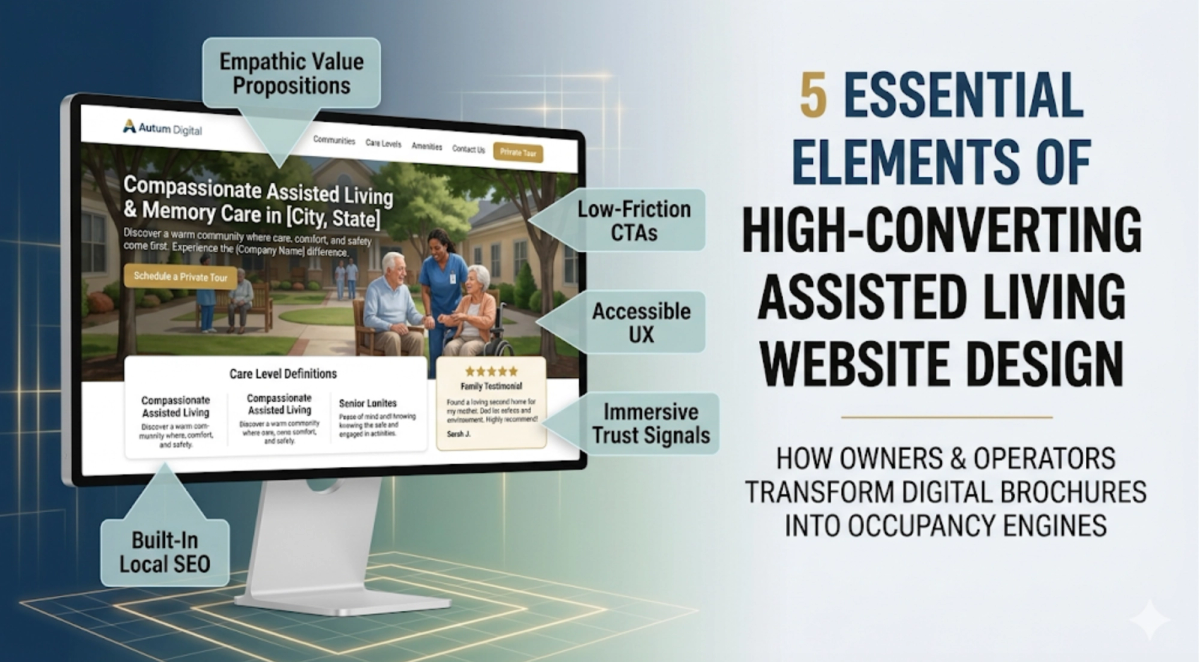
5 Essential Elements of High-Converting Assisted Living Website Design
May 19, 2026
For owners, operators, and marketing directors of senior living portfolios, a digital footprint is often mischaracterized as a creative asset. Portfolios invest significant capital into modern aesthetics, sleek color palettes, and standard stock photography featuring vibrant seniors enjoying activities. Yet, despite these investments, many of these platforms struggle to generate meaningful digital inquiries.
The underlying problem is structural: most senior care sites are built like static brochures rather than functional utilities.
When a family searches for senior care, they are rarely browsing casually. They are often navigating a high-stakes, emotionally heavy life transition—frequently accelerated by an unexpected clinical event, a hospital discharge, or a sudden decline in a loved one’s safety at home. In these intense moments, a website cannot afford to be an ambiguous creative experiment. It must serve as an intuitive, clear, and empathetic guide.
To shift your platform from an online placeholder into a high-performing lead generation engine that builds immediate trust and stabilizes census metrics, your digital presence must master these five essential structural elements.
1. Clear, Empathetic Value Propositions Above the Fold
The first three seconds of a user’s interaction with your homepage dictate whether they will explore your community or bounce back to the search engine results page. When a stressed adult child lands on a senior living platform, they immediately try to answer three fundamental questions:
- Where is this community located?
- What specific levels of care do they provide?
- Are they qualified to handle my family’s unique situation?
Many traditional designs obscure these answers behind abstract, emotional taglines like "Welcome to the Next Chapter" or "Live Your Best Life." While well-intentioned, these phrases fail to provide immediate practical utility.
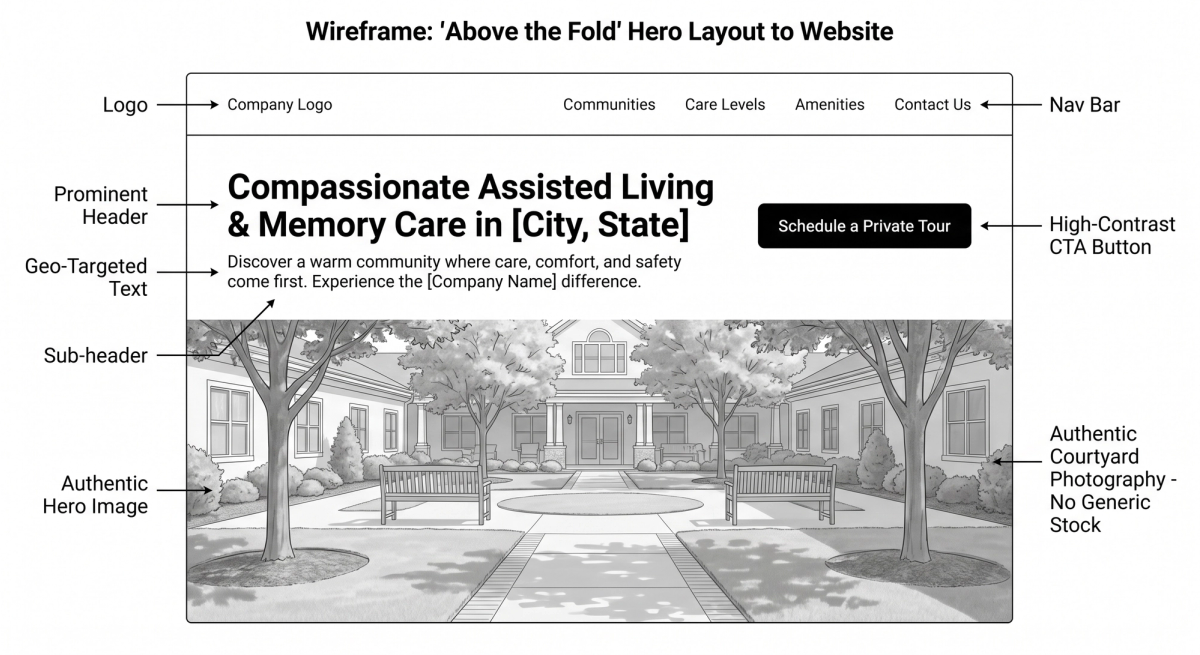
High-converting senior living web design places concrete, geo-targeted positioning directly above the fold (the area of the page visible without scrolling).
Actionable Design Adjustments:
- Replace Ambiguity with Specificity: Use direct headers like "Personalized Assisted Living and Memory Care Communities in [City, State]."
- State the Care Continuum Immediately: Clearly label if your facility offers independent living, skilled nursing, assisted living, or specialized memory support. This prevents wasted administrative time filtering out unqualified inquiries from families seeking a level of care you do not provide.
- Anchor with Contextual Relevance: If your portfolio operates across multiple markets, leverage a smart, dynamic location picker or a clear multi-location directory link right in the main hero space to route families directly to the care home nearest to them.
2. Intent-Driven, Low-Friction Conversion Funnels
A common mistake on senior care platforms is treating all traffic as if it possesses identical intent. Some websites overwhelm top-of-funnel users by demanding a high-commitment action immediately, such as a prominent header banner shouting "Apply Now" or "Deposit Today." Conversely, other sites bury their contact mechanisms entirely, forcing families to hunt through secondary submenus just to ask a question.
High-converting platforms map conversion points directly to the user’s exact stage in the decision-making cycle. This is achieved by creating distinct, low-friction pathways for both immediate, high-intent buyers and nurturing-intent researchers.
High-Intent Pathways (The Primary Call to Action)
For families actively looking to transition a relative within the next 30 days, the primary objective is to get them inside the physical building. Research from the Senior Housing News Market Survey indicates that physical community tours remain the single highest-converting step in the senior care sales cycle, with high-performing communities converting up to 40% to 50% of in-person tours into permanent move-ins.
Therefore, your primary, high-contrast desktop and sticky mobile CTA should be single-focused: "Schedule a Private Tour" or "Book a Visit." The form associated with this action must be optimized for minimal friction—asking only for a name, email, phone number, and preferred date/time.
Nurturing-Intent Pathways (The Secondary Call to Action)
Many users are in the early stages of research, evaluating options six to twelve months in advance. They are not ready to book an in-person tour, but they are highly hungry for information regarding pricing, apartment floor plans, and care amenities. If you do not capture their information at this stage, they will leave your site and forget your community name.
Capture this valuable segment by offering gated, high-utility downloadable resources:
- "Download Our Transparent Floor Plans & Pricing Guide"
- "The Assisted Living Checklist: How to Evaluate Local Care Homes"
By capturing an email address via a secondary CTA, your marketing team can deploy automated, educational email nurturing sequences that keep your portfolio top-of-mind as the family moves closer to a final decision.
3. Senior-Friendly UX and Strict Digital Accessibility (WCAG Compliance)
While adult children (typically aged 45 to 65) represent the primary search demographic driving digital research for assisted living, aging seniors themselves frequently participate in the evaluation process. Furthermore, the Web Content Accessibility Guidelines (WCAG) are no longer optional best practices; they are foundational for digital compliance, user experience, and baseline technical performance.
If your platform features tiny font sizes, low-contrast text layouts, or complex hover-dependent navigation menus, users with visual, motor, or cognitive challenges will abandon the experience.
Vital Accessibility Checkpoints:
- Contrast and Typography: Maintain a strict minimum contrast ratio of 4.5:1 for standard text elements against their backgrounds. Utilize clean, legible sans-serif typefaces (like Open Sans or Roboto) and set baseline body copy to a highly legible size of at least 16px to 18px.
- Simplified Macro-Navigation: Avoid intricate multi-tiered dropdown hover menus that require highly precise mouse control. Implement clear, broad navigation categories. Ensure that your core service and destination pages, like we have on this site with Autum Digital's Website Development Services, are easily reachable within a single, predictable click from any location on the platform.
- Flawless Technical Core Web Vitals: A website's performance is deeply intertwined with its user experience. Slow-loading pages cause severe friction, particularly for families trying to pull up address information, care details, or phone lines on mobile networks while standing inside a clinical office or hospital wing. Optimizing server response times and asset compression ensures that pages render instantly across all consumer devices.
4. Radical Transparency via Immersive Trust Signals
Choosing a long-term care setting is a high-stakes financial and personal choice. Families are looking for clear indicators of institutional credibility, safety, and clinical excellence before they risk handing over the care of an aging parent. If your web design relies completely on generic corporate stock assets, your platform will feel cold, institutional, and untrustworthy.
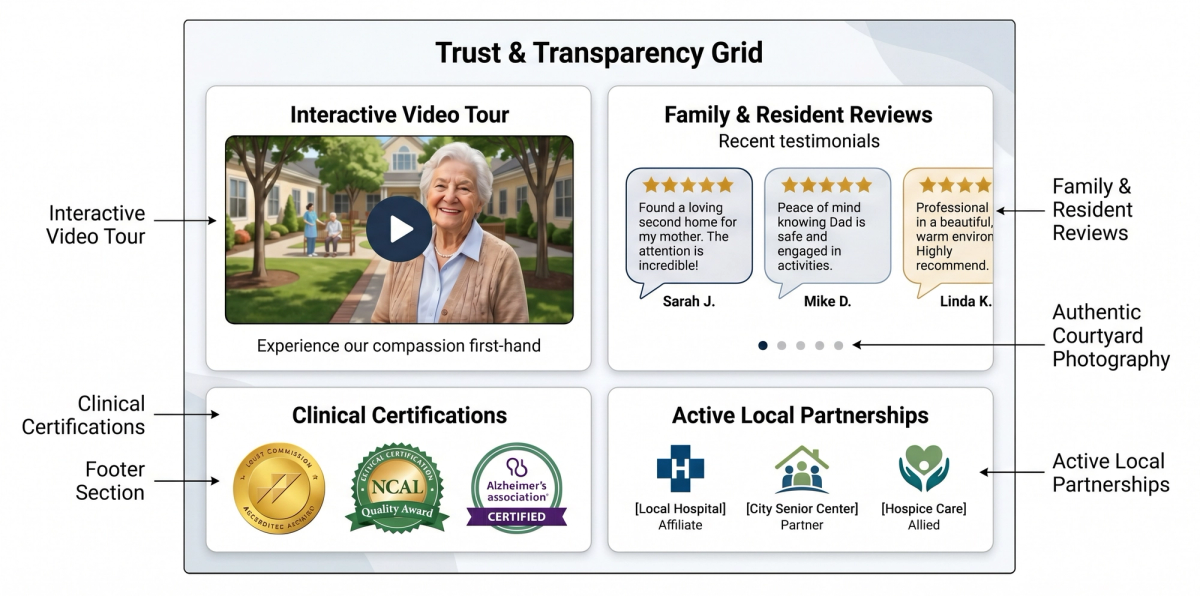
High-converting web design incorporates authentic, native social proof directly into the visual layout of every primary landing page.
Core Components of a High-Trust Interface:
- Authentic Visual Media: Invest in professional, high-resolution photography and video walkthroughs of your real common areas, private apartments, and dining experiences. Showing your actual staff interacting warmly with residents builds immediate psychological safety that stock photos cannot match.
- Prominent Social Proof Integration: Do not relegate your reviews to a hidden, standalone page. Embed real, verified family testimonials directly onto your high-traffic destination pages. Feature specific praise regarding the care team, the responsiveness of the nursing staff, and the overall cleanliness of the campus.
- Authority Badges and Local Signifiers: Highlight your community's external validations. Proudly display industry badges, state compliance recognitions, and local partnerships. If your portfolio manages active outreach or patient acquisition strategies, showcasing these local validation marks directly helps establish regional authority.
5. Built-In Local SEO Infrastructure
A beautiful web interface is completely ineffective if families in your immediate geographic radius cannot find it when searching Google. In the senior care sector, search intent is fundamentally local. Users search for solutions using highly specific geographic modifiers (e.g., "assisted living near me," "care homes in [City Name]," or "memory care facilities near [Neighborhood Name]").
To convert this localized search volume into direct website inquiries, your backend platform architecture must naturally signal its geographical relevance to search engine crawlers.
Essential SEO Architecture Steps:
- Dedicated Hyper-Local Landing Pages: If your portfolio operates multiple communities, avoid grouping them onto a single, generic contact page. Each community needs its own individual, highly optimized landing page. This page must feature unique copy describing that specific facility's amenities, team, coordinates, and nearby landmarks.
- Structured Data & Schema Markup: Implement local business schema markup on the backend of every location page. This structured data acts as an explicit signal to search engines, precisely detailing your exact corporate name, physical address, direct phone line, coordinates, and operating hours. This is a critical factor for ranking within Google’s high-visibility Local 3-Pack map results.
- Strategic Keyword Hierarchy: Ensure your target terms are woven naturally into your code hierarchies ($H1$ headings, $H2$ subheaders, and page meta data). For example, your primary location header should explicitly state "Assisted Living and Personalized Senior Care in [City, State]" instead of a generic phrase like "Our Beautiful Facility."
Moving From a Brochure to an Occupancy Engine
Stabilizing portfolio census metrics and scaling inbound inquiry volume requires moving past superficial design choices. High-converting senior care web platforms balance clinical authority, absolute transparency, simple accessibility, and clear, intent-driven conversion pathways.
If your current senior care or healthcare website is not actively producing qualified tour bookings, it is likely missing one or more of these foundational pillars. Your website should be your hardest-working marketing asset, quietly providing clarity to families during their most challenging moments and building a seamless path directly to your community's front door.
Ready to Maximize Your Digital Performance?
At Autum Digital, we specialize in building compliant, high-utility web platforms tailored explicitly for healthcare groups and multi-location senior care portfolios. We eliminate vanity guesswork and design custom digital systems focused entirely on patient and resident acquisition.
Discover exactly where your digital platform is losing qualified leads. Contact us today to request a comprehensive Website Conversion & Search Performance Audit, or explore our specialized growth insights on How to Measure ROI in Healthcare Digital Marketing to unlock the true potential of your community's digital presence.